



Is it safe to be in your body?
Your body is your home for this lifetime — the place through which you experience connection, sensation, intimacy, and meaning. Through its signals and language, it continuously offers information about what you need and what matters to you.
And yet many of us have learned to live primarily in the mind — functioning, analyzing, holding ourselves together, while gradually losing touch with what we actually feel. In a world that values productivity over presence, this disconnection can leave us feeling scattered, overwhelmed, or somehow far from our own inner center.
Somatic work offers a gentle invitation to return. To listen inward, reconnect with your experience, and allow body, mind, and emotions to work together rather than apart.
Your body is not a problem to fix — it is your biggest resource.
I grew up near Bielefeld as the daughter of Polish immigrants.
My journey into body work began with movement. Around the age of sixteen, I discovered dance — primarily African Contemporary Dance, along side other styles. Since then, dance has remained one of my greatest passions and most meaningful forms of expression.
At the age of nineteen, I moved to Thailand, where I spent a year living, traveling, and studying. I immersed myself in the study of Thai Massage, learning from experienced teachers and established schools. After relocating to Berlin, I continued expanding my practice through trainings in Deep Tissue Massage, Prenatal & Postnatal Massage, Rebozo techniques, Reiki, Somatics, and trauma-informed approaches.
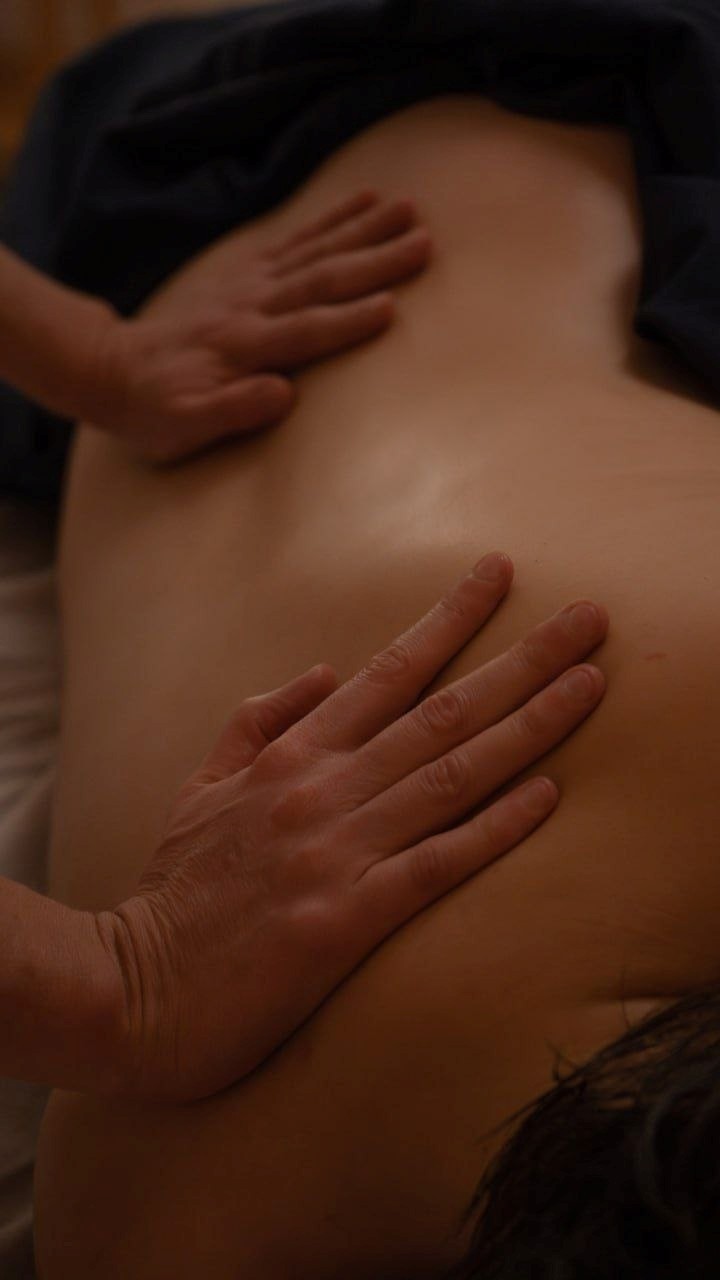
Over time, these influences have woven together into my own unique style of bodywork — one that addresses physical tension while also creating space for emotional processing, energetic balance, and deeper self-connection. My work is rooted in presence, deep listening, and intuitive touch, meeting each person as a whole rather than focusing solely on symptoms.
Alongside this practical path, I completed a Bachelor's degree in Cultural Theory and European Ethnology at Humboldt Universität zu Berlin, and a Master's in Social and Cultural Anthropology at Freie Universität Berlin. Throughout both, my central interest was the same question I explore in the treatment room:
How does the body carry culture, social behavior, and lived experience?
I remain a student at heart and strongly value learning from those who have been an inspiration to me. Some of my teachers are listed below — I whole heartedly recommend studying with them and, where possible, experiencing their work firsthand.


For my Master's I conducted an ethnographic research, where I immersed myself in a Berlin-based dance community rooted in queer club culture, Gaga Movement Language, and community-based practices. I explored how their movement events function as contemporary urban rituals — and how participants undergo transformation through them. Central to this was understanding how social norms and political power structures become embodied — leading to marginalization and discrimination — and how movement can become a means of resistance and reclamation: a space for self-expression, agency, and belonging.
This research continues to shape how I work with people today — my curiosity about their stories, my attention to how the worlds we grow up in live inside our bodies, and my conviction that healing is never purely personal but happens in relationship. The social landscape we carry within us can shift when we begin to move, express, and connect differently. That is as true in the treatment room as it is on the dance floor.
Each of us carries a story that is uniquely our own — rooted in where we come from, what we have lived through, what we have lost, learned, and long for. Our stories hold our wounds and our resilience, our questions and our becoming.
As an Anthropologist, I have always been fascinated by the stories of people, communities, and cultures. What makes us human? What makes us the way we are? And what connects us across our differences?
As a Somatic Practitioner, I listen to your story — not only the one told in words, but the one held in your body, in your sensations, patterns, and ways of relating to yourself and the world. What defines you? Where do you long to express yourself more fully, take up more space, or live closer to your own truth?
Some stories may not yet feel safe to share elsewhere. And yet it is often within these tender, hidden places that our deepest strength, uniqueness, and authenticity reside. My role is to accompany you with curiosity and care — witnessing what wants to be heard, acknowledged, and integrated. What has been hidden can become a source of direction. What has been silent can find its voice.
Some of the practices that are part of my work did not originate in the cultural environment I grew up in. This includes traditions such as Rebozo techniques from Mexico, Thai Yoga Massage, and also, African dance forms.
I feel deeply grateful for the opportunity to learn from these practices and the people who carry them — and for the privilege of travelling, being welcomed into different communities, and expanding my understanding of the world through those encounters. I strive to approach these traditions with respect, humility, and an ongoing awareness of their roots. While I cannot claim them as my own, I seek to honor the lineages and communities from which they emerged.
When I share these practices, I do so in the spirit in which they have long been cultivated — to support well-being, connection, healing, and a deeper relationship with ourselves and one another. Touch, movement, ritual, and storytelling have been essential ways of caring for human life across cultures and throughout history, long before our own times.
I am a student of those lineages, not their owner.
